Targets to timelines: the realities shaping energy transition
Muhammad Ekrahm shares his perspective on hydrogen ambitions, transition misconceptions, supply chain pressures and what must change to accelerate delivery.

Will the 2030 industry targets for hydrogen be met?
While 2025 was a challenging year for the hydrogen sector, with many flagship projects paused and shelved, there were important signs of progress. Several projects reached final investment decisions, with construction now underway.
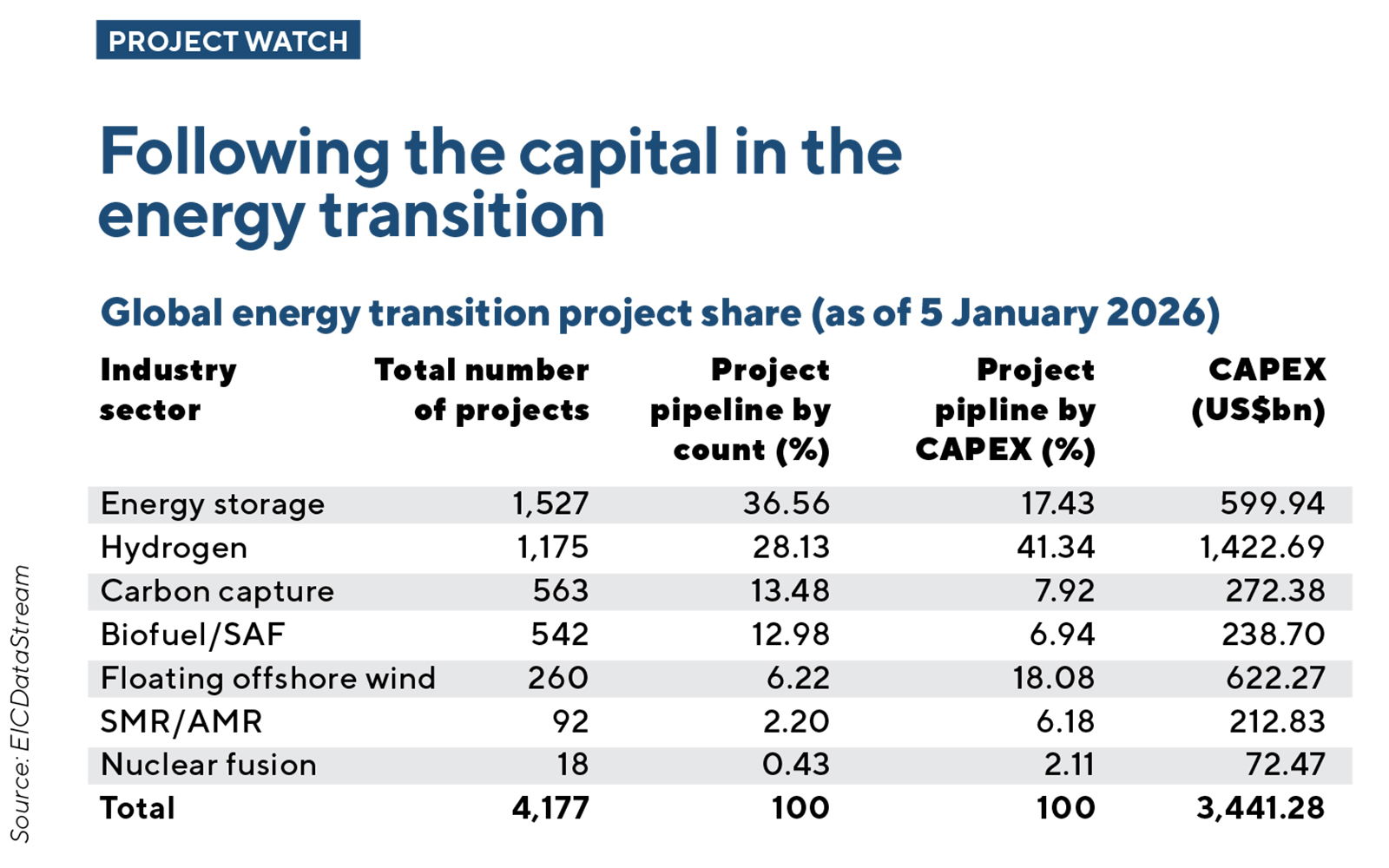
EIC is currently tracking more than 1,175 hydrogen projects globally on EIC DataStream, with a total CAPEX of US$1,422.6bn. Although the majority remain in the feasibility and engineering stages, the steady movement of projects into construction highlights developers’ commitment to achieve the 2030 national ambitions.
Regions such as the Middle East and Asia are targeting extremely large hydrogen volumes by the end of the decade, but these goals are unlikely to be realised by 2030 without a rapid acceleration in financing, permitting and renewable power availability. Ongoing project delays, high production costs, weak demand signals and slow infrastructure build-out are impeding project deployment. As the sector matures and realism sets in, many existing 2030 targets are likely to be revised or deferred.
What needs to happen for the industry to get close to these targets?
The industry must shift from ambition to execution, which means tackling the structural, financial and system-level constraints that slow delivery. Priorities include grid upgrades, more efficient capital deployment, diversified supply chains for clean energy technologies, and strong, consistent policy support.
An example of effective intervention is Germany’s H2Global hydrogen auction mechanism, which provides long-term, government-backed demand certainty. This significantly improves project bankability, enables hydrogen production and infrastructure scale-up, and supports energy security objectives.
Grid expansion works are also ramping up. Australia is advancing its EnergyConnect and Renewable Energy Zones transmission lines to deliver green energy from production zones to demand centres. Meanwhile, in the UK, Ofgem has approved a multi-billion investment package under the RIIO-3 framework, enabling the connection of more than 120GW of low-carbon generation, as well as its Great Grid Upgrade programme.
What is the market’s biggest misconception about energy transition?
That the energy transition is a fast, linear and purely technological switch from fossil fuels to renewables. In reality, it is a complex, capital-intensive and system-wide transformation that involves infrastructure, regulation, storage and grid flexibility, and which will unfold unevenly across regions.
There is also a widespread assumption that rapid renewable capacity additions automatically translate into reliable, low-cost energy systems, which simply isn’t the case.
Another misconception is the belief that hydrocarbons will become irrelevant early in energy transition. In practice, natural gas remains a critical transition fuel, ensuring system reliability and affordability. Countries such as Germany and the UK rely on gas-fired power to balance their growing shares of wind and solar, Japan uses liquefied natural gas (LNG) to ensure energy security, and China deploys gas to displace coal while supporting system flexibility. LNG use is especially important in South East Asian economies, which depend on gas as a transition fuel, allowing them to meet rising energy demand while supporting the renewables scale-up.

How are geopolitics and supply chain pressures reshaping energy transition delivery?
Geopolitical tensions are directly affecting and putting pressure on the supply chain. Long, complex global supply chains are vulnerable to geopolitical tensions, trade barriers and logistic challenges. Recent trends, such as tariffs, export curbs and policy adjustments, add cost and lead times to clean energy equipment and component imports.
A clear example is the UK’s Hornsea 4 offshore wind project, which stalled due to rising supply chain pressures, higher interest rates and escalating construction costs. Even in mature markets, cost inflation and finance challenges are undermining project economics.
The biggest misconception in the market right now is that the energy transition is a fast, linear, and purely technological switch from fossil fuels to renewables
However, geopolitics is also accelerating clean energy efforts by making energy transition a national security issue. Governments are fast-tracking battery manufacturing and critical mineral processing capacities to enhance energy independence and develop local supply chains.
India, for example, has rolled out targeted industrial policies such as Production Linked Incentive schemes for fuel cell batteries, solar PV modules and wind components, alongside import duties on solar modules, to rapidly scale domestic manufacturing and reduce reliance on overseas suppliers. These measures have already triggered significant investments in gigawatt-scale battery plants and integrated solar manufacturing facilities.
Where are the biggest supply chain opportunities for EIC members in the next two to three years?
EICDataStream is currently tracking 4,177 energy transition projects around the world, with total estimated CAPEX of US$3.44tn. Energy storage dominates the pipeline at 37%, followed by hydrogen at 28%, carbon capture at 14% and biofuels and sustainable aviation fuel (SAF) at 13%. Floating offshore wind and small or advanced modular nuclear reactors (SMRs and AMRs) also represent growing opportunities.
As demand outpaces manufacturing capacity, pressure is building across supply chains for electrolysers, wind turbines, battery storage systems, gas turbines and nuclear components. Rising costs and delivery risks are prompting both developers and governments to prioritise local and regional supply chains.
This opens clear opportunities for EIC members across manufacturing, engineering, equipment supply, logistics and specialist services. Supporting localisation, capacity expansion and supply chain resilience will be critical in easing bottlenecks, stabilising project economics and ensuring momentum in the next phase of energy transition deployment.
Q&A with Muhammad Ekrahm, Energy Analyst, EIC Kuala Lumpur
Image credit | iStock




Follow us
Advertise
Free e-Newsletter