The working capital challenge: improving access to finance for SMEs
SMEs are being asked to deliver bigger, more complex projects – but outdated financial frameworks and risk-heavy contracts are holding many back. Capital and finance issues must be resolved for a resilient supply chain.

As demand for energy grows, the pressure is on to scale supply.
Global energy capacity additions hit record highs in 2023, 2024 and 2025 – a trend that is likely to continue as hundreds of gigawatts are added each year.
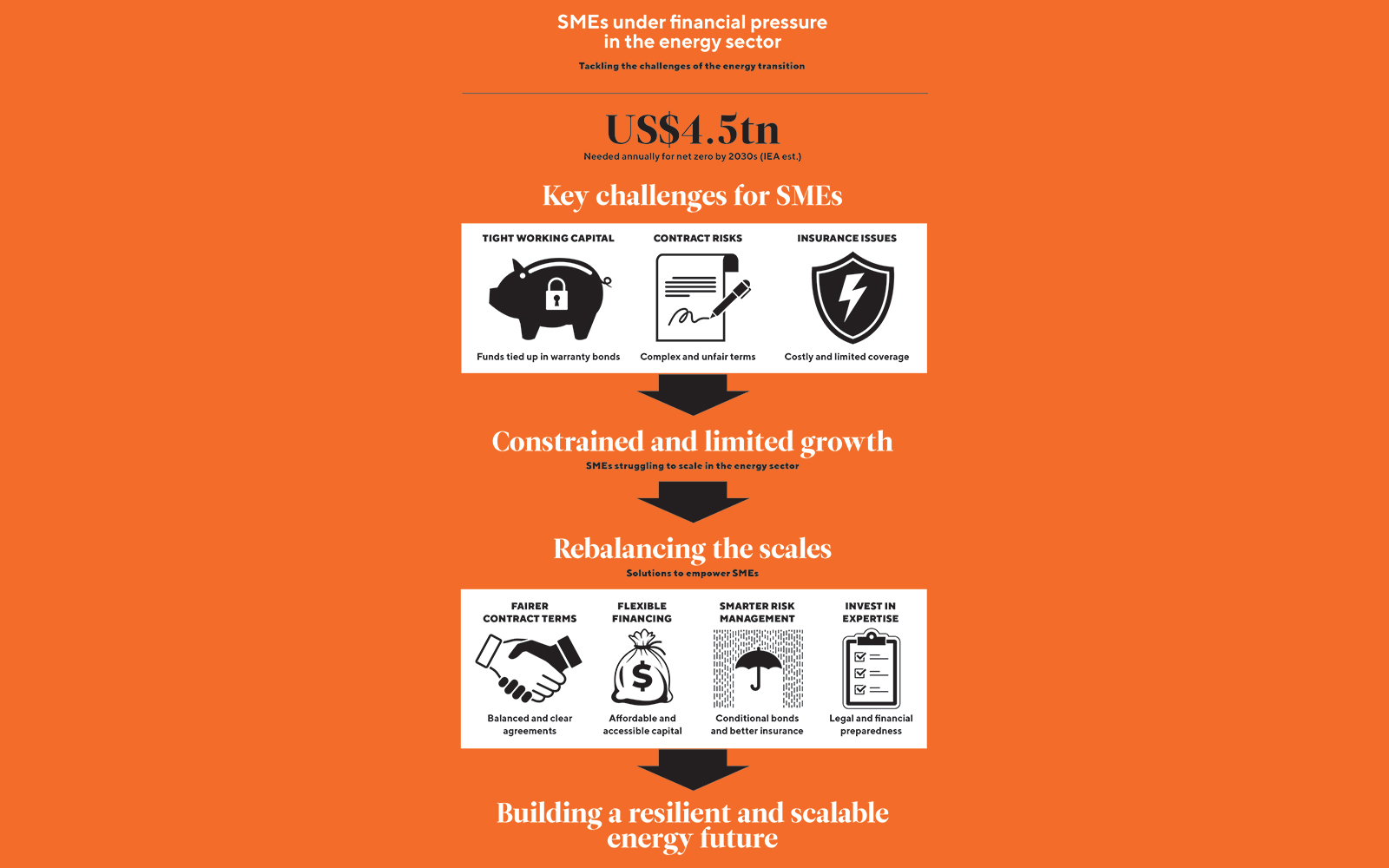
International Energy Agency (IEA) estimates suggest that the US$2tn in clean energy investment seen in 2024 represents less than half the roughly US$4.5tn needed each year by the early 2030s to achieve net-zero emissions by 2050. But governments globally are heeding the call. In the UK, more than £1.5bn has been committed to domestic clean energy projects, with ambitious targets set through the Clean Power 2030 Action Plan.
For small and medium-sized enterprises (SMEs), any efforts to bridge the investment gap present significant opportunities. Many will be asked to take on and deliver larger, more complex contracts. However, beneath that opportunity lies a less appealing reality: many smaller firms are limited in the number of projects they can take on, largely because they face severe constraints to their working capital. This, in turn, limits their ability to scale.
Consider warranty bonds, also called maintenance or defects liability bonds. These are financial guarantees that a contractor or supplier will correct defects in their work or product during a specified warranty period. For SMEs, this means significant cash reserves can be tied up for extended periods, limiting their ability to use that capital to take on more projects.
“A typical warranty bond is, at best, around 10% of a contract’s value, and can be enforced for several years,” says Ann Johnson, Non-Executive Director at EIC. In the case of a £1m contract, she explains, a 10% bond would mean that £100,000 is locked up. If the bond then costs 3% per year, £3,000 would need to be paid annually. Then, even after the project is completed, the bond might fall from 10% to 5% for the warranty period, meaning another £50,000 remains tied up.
“This cumulatively adds up,” Johnson says. “If a company does two or three contracts per annum, then they’ll quickly find themselves with £150,000 that’s tied up and can’t be reinvested. Add in extra requirements like parent company guarantees and suddenly businesses find that much of their free cash is locked away.
“It can be helped if you qualify for UK Export Financing. However, that can be a challenging landscape for a diversifying company which may already have a negative EBITDA for previous years.”
Small firms, heavy loads
Warranty bonds are just one part of the problem. Financial and contractual risks associated with energy projects are often pushed down the supply chain, leaving SMEs bearing the brunt.
“The client generally has an onerous burden from the investors, which they place on the prime Tier 1 engineering, procurement and construction contractor, which will in turn look to mitigate their risk down the chain,” says Johnson.
“Most SMEs don’t have in-house lawyers and are therefore reliant on their previous contractual knowledge – something that is no match for a large Tier 1 firm that might have a whole stable of qualified lawyers negotiating contracts.
If a company does two or three contracts per annum, then they’ll quickly find themselves with £150,000 that’s tied up and can’t be reinvested Ann Johnson, Non-Executive Director, EIC
“Ultimately, it means that individual suppliers are carrying ever-increasing contract risk, with little to no means of mitigating it, and so they’re generally forced to seek insurance or decline work as their risk increases.”
Banks and project financiers often require insurance as a prerequisite for lending or investing, yet this also comes with challenges – particularly in renewables, where increasing numbers of risks and claims are prompting insurers to adjust their coverage terms and pricing.
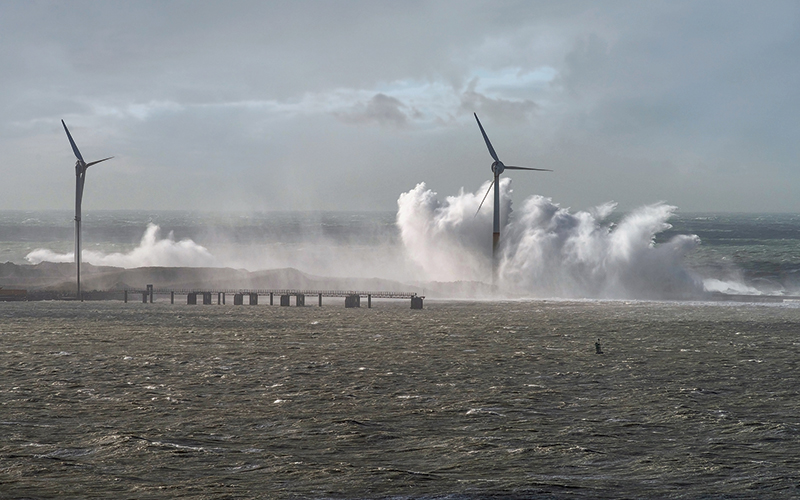
Indeed, 2024 saw record insured losses for renewables in Europe due to a higher volume and severity of extreme weather events. A 2025 report from Zurich, meanwhile, found that renewable energy assets face significantly more physical climate risk than fossil fuel-based infrastructure, with 83% of Europe’s clean energy generation set to be deemed high risk by 2030.
As a result, many projects are now prohibitively expensive to insure or face significant coverage exclusions for risks such as flooding that can affect project viability.
Administrative burdens
SMEs face a cocktail of challenges – capital that is costly and hard to access, projects that are difficult to insure, and constraints such as warranty bonds that can leave finances tied up for years, making critical projects non-bankable. Many smaller firms are already on the back foot, with limited headcounts and operational capacity that they can’t afford to have bogged down by complex contractual agreements.
Fairer contract terms, more flexible bonding requirements and tailored finance solutions would certainly help Ann Johnson, Non-Executive Director, EIC
“For SMEs, contract documentation can be onerous,” says Ben Vincent, Global Sales and Marketing Manager at Destec Engineering, which specialises in high-pressure containment solutions. “The time it takes to prepare has a huge impact, when working on multiple projects simultaneously can already be a challenge when it comes to managing capacity and lead times.
“While we would like to tender for all projects, we may turn down certain opportunities because of this – perhaps if we think our chances of securing the order are less likely.”
Administrative burdens are putting SMEs in a position where they must become increasingly selective – and that’s a problem, constraining industry capacity and competitiveness at a time when the energy sector needs to grow.
Johnson believes many SMEs are stuck between a rock and a hard place – particularly those looking to diversify outside of oil and gas.
“They’re naturally nervous of entering new markets,” she says. “The huge contract risks don’t generally tally with great rewards. There are then further frustrations with legal issues that need to be managed in unfamiliar legal markets, all while continuing to service warranty obligations.”
Rebalancing the scales
These challenges need to be addressed. It’s regularly acknowledged that SMEs are the backbone of the economy. In the EU, they represent 99% of all businesses, employ more than 80 million people and account for half of GDP. Yet in the energy sector, working capital challenges, unfavourable contract obligations, significant risks and limited access to affordable finance are hampering their ability to thrive.
Without change, SMEs will be constrained – unable to grow and support the energy sector’s much-needed expansion.
“Fairer contract terms, more flexible bonding requirements and tailored finance solutions would certainly help,” says Johnson.
For SMEs, contract documentation can be onerous – the time it takes to prepare has a huge impact Ben Vincent, Global Sales and Marketing Manager, Destec Engineering
There are several mechanisms that could be leveraged and deployed in each of these areas. More balanced agreements could avoid pushing risks disproportionately onto SMEs, defining clearer liability limits and shorter warranty periods. Conditional bonds, phased reductions or insurance-backed guarantees could free up working capital, while lenders and policymakers could introduce innovative products and models such as project-specific credit lines and export finance to make capital more accessible and affordable.
Systemic changes such as these are crucial, but SMEs should also take proactive steps to improve their position. For example, robust financial reporting and forecasting can demonstrate stability and manage perceived risk among lenders and insurers. Investing in compliance and legal expertise may also be logical, preventing exposure to overly burdensome terms and allowing you to negotiate against imbalances through contract reviews. Likewise, looking into schemes such as UK Export Finance may prove fruitful if this hasn’t already been explored.
If the energy transition is to succeed, SMEs must not be constrained by outdated financial and contractual frameworks. Businesses can take steps to ease risk concerns and explore affordable finance options, but broader reforms are needed.
Fairer terms, accessible capital, and smarter risk-sharing aren’t just good for business, but essential to build the resilient, scalable supply chains demanded by a net-zero future.
Ben Vincent, Global Sales and Marketing Manager, Destec Engineering
Image credit | iStock



Follow us
Advertise
Free e-Newsletter