How X-Energy's Xe-100 is redefining the nuclear landscape
As the global energy transition accelerates, X-Energy’s innovative Xe-100 small modular reactor is attracting billion-dollar investment and reshaping how industry thinks about clean, dispatchable power.
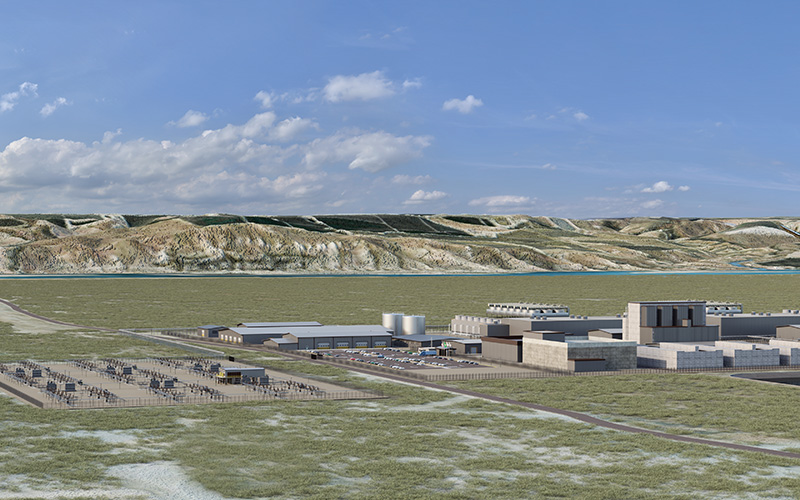
X-Energy is rapidly establishing itself as a pioneer in advanced nuclear energy, with the Xe-100 high-temperature gas-cooled reactor at the forefront of its small modular reactor (SMR) offering.
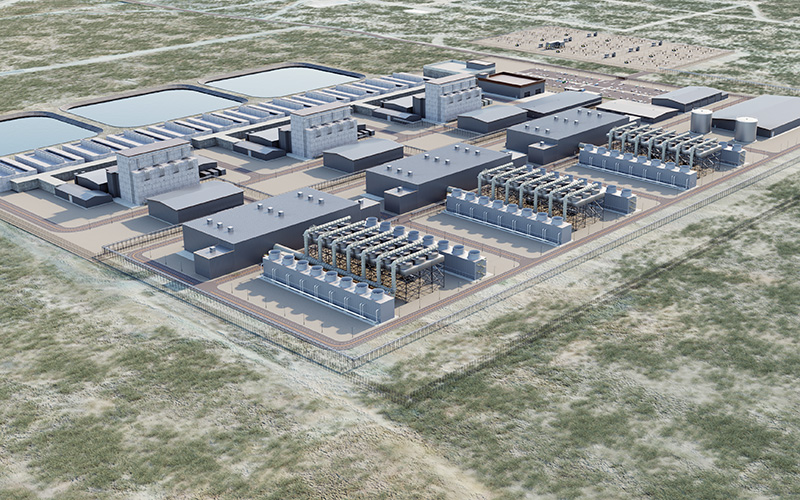
Capable of generating 80MW as a standalone unit, the Xe-100 can be scaled into a ‘four-pack’ configuration to deliver a combined electric output of 320MW. Using helium as its coolant, the Xe-100 produces a thermal output of 200MWth, and it is this capability that truly sets it apart from competing SMR designs.
Unlike conventional nuclear power plants, which serve a single purpose, the Xe-100’s high-grade thermal output enables it to simultaneously feed clean electricity to the grid and supply process heat directly to energy-intensive industries. That dual-purpose functionality means it is not merely as simple power source, but a flexible industrial energy solution with transformative potential.
A fuel like no other
At the heart of the Xe-100’s performance credentials lies its pebble-bed core, packed with thousands of tristructural isotropic uranium fuel particles, which undergo the fission reaction. Tristructural isotropic uranium fuel also offers enhanced safety and is considered ‘meltdown proof’ due to the design of the particles: each has its own containment system, allowing the fuel to be more resistant to corrosion, irradiation, oxidation and high temperatures. The Xe-100 is in high demand thanks to these impressive design features, with plans already being made for 12GW of deployment.
Amazon’s US$500m vote of confidence
The commercial momentum behind the Xe-100 crystallised in October 2024 when Amazon announced a US$500m investment in X-Energy through its Climate Pledge Fund, targeting the development of 5GW of new nuclear capacity by 2039.
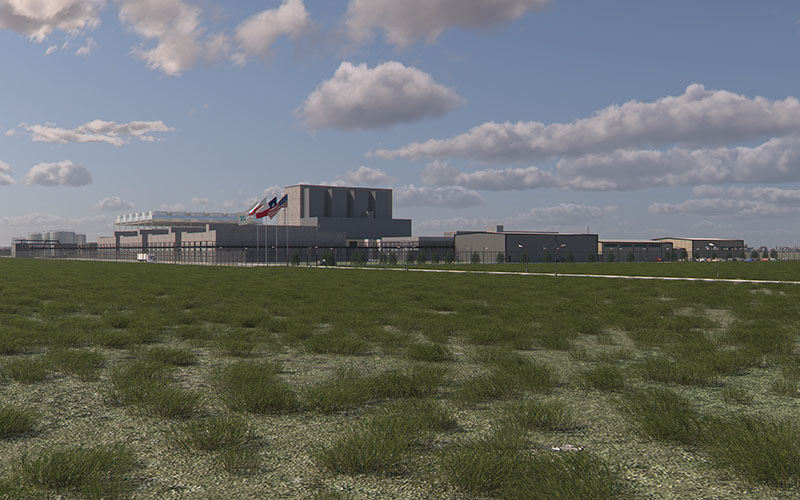
The first project under this agreement is the Cascade Advanced Energy Facility, which is being developed alongside Energy Northwest in Washington, US. The project will be built near the existing Columbia Generating Station and will consist of four Xe-100 reactors giving an initial capacity 320MW; this will increase to 12 reactors with 960MW of capacity.
The Xe-100 can simultaneously feed clean electricity to the grid and supply process heat to energy-intensive industries
Amazon has the rights to purchase electricity from the initial phase of 320MW, which they intend to use to power artificial intelligence tools and cloud services in the region. The facility will also support the technology giant’s sustainability goals, specifically by offering around-the-clock carbon-free energy to reduce carbon emissions. Energy Northwest is currently engaging with the US Nuclear Regulatory Commission regarding pre-application activities to obtain a construction permit for the project.
Cascade: building the supply chain
The project has already made considerable progress compared to other SMR projects being developed globally, with the appointment of a joint venture between Aecon, Kiewit Nuclear Solutions Co and Black & Veatch in October 2025, one year after the announcement of the project. The joint venture, known as Cascade Nuclear Partners, will be responsible for designing and building the initial phase of the project, with construction expected to begin by the end of the decade and the reactor to become operational in the 2030s.
More than 1,000 construction jobs will be created for the project, with 100 permanent roles in nuclear operations, engineering and other specialist positions. An education centre, the Energy Learning Center, is being developed to support this workforce; it has received funding from the US Department of Energy and will house an education simulator that mimics the control room for the Xe-100 reactor. Students from the Columbia Basin College will be able to obtain valuable skills and experience at the education facility to help them enter the advanced nuclear energy sector.
With more than 11GW already planned globally, X-Energy is fast becoming one of the defining forces in clean energy
Contracts have also been signed with Doosan Enerbility and SGL Carbon LLC. Doosan Enerbility are to supply forgings for the Xe-100 reactor, signed in December 2025, and at the beginning of 2026, a 10-year framework agreement was signed with SGL Carbon LLC for the supply of graphite, which will also be supplied for the reactor. Graphite reserves have been made for the project, with production expected to commence in the second half of 2026.
Texas, the UK and beyond
As well as the Cascade Advanced Energy Facility, X-Energy is deploying Xe-100 reactors at Dow’s Seadrift facility in Texas, also in a 320MW four-pack configuration with agreement, with SGL Carbon LLC applying to the project. Graphite production has already begun in a US$100m contract over the next three years.
In addition, the Xe-100 reactor is being explored for deployment in the UK. Centrica and X-Energy signed a Joint Development Agreement in September 2025 as part of the UK-US Atlantic Partnership for Advanced Nuclear Energy, and plan to install a 6GW fleet of Xe-100s across the UK. The first 960MW is being planned for development in Hartlepool and will be built adjacent to the operational Hartlepool Nuclear Power Plant. In March 2026, Centrica and X-Energy submitted a joint proposal to the UK government’s newly established Advanced Nuclear Pipeline, which aims to accelerate the development of advanced nuclear projects.
Alberta, Canada, is also emerging as a potential deployment location, further expanding X-Energy’s geographic footprint. With more than 11GW of capacity already planned globally, the company is no longer simply a technology developer – it is fast becoming one of the defining forces in the clean energy transition.
Project pipeline
Small reactors, big ambitions: the appeal of SMRs and AMRs
Across 10 nations, small modular reactors are reshaping energy futures
Of the 270 nuclear projects currently being tracked on EICDataStream, 103 (approximately 38%) are small modular reactor (SMR) and advanced modular reactor (AMR) initiatives. Their appeal is clear: advanced nuclear technologies deliver consistent, low-carbon baseload power, are considered safer than traditional reactors, and are increasingly cost-competitive, making them an attractive solution for hard-to-abate industries and power-hungry data centres.
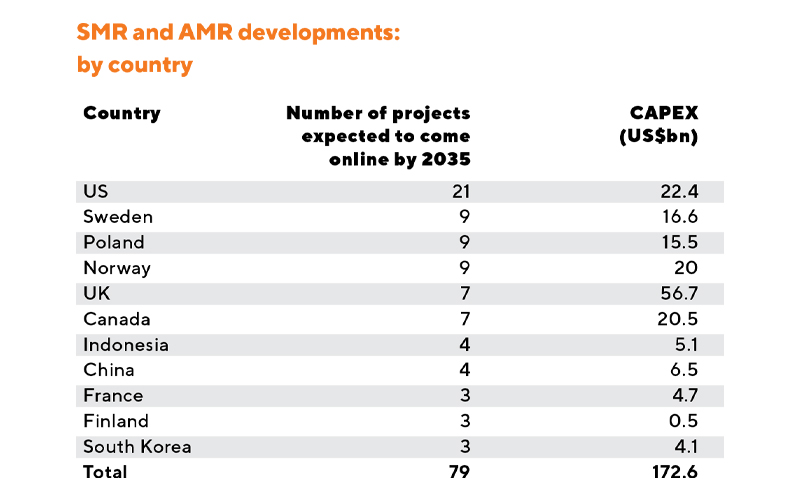
Ten nations are driving the 79 SMR and AMR projects in active development, with all expected to come online by 2035. The US leads the way with 21 projects, accelerated by the introduction of the Reactor Pilot Program, which aims for three advanced reactor technologies to reach criticality by 4 July 2026 and to fast-track these designs towards commercialisation.
In Europe, SMR and AMR interest is growing as nations target net zero by 2050. Poland leads the way as it looks to transition away from coal. The nation’s main developer, Orlen Synthos Green Energy, has signed an agreement with GE Vernova Hitachi to explore deploying the BWRX-300 reactor across seven proposed Polish projects. More projects are expected to be announced in the coming years as nations look to nuclear and its emerging technologies to increase energy security and reduce reliance on fossil fuels.
By Jack Boggis, Energy Analyst, EIC London
Image credit | X-Energy

Follow us
Advertise
Free e-Newsletter