Facing off to wind
Offshore wind is developing at two speeds: fixed-bottom leads near-term investment decisions and subsidy awards, while floating wind still lags behind.
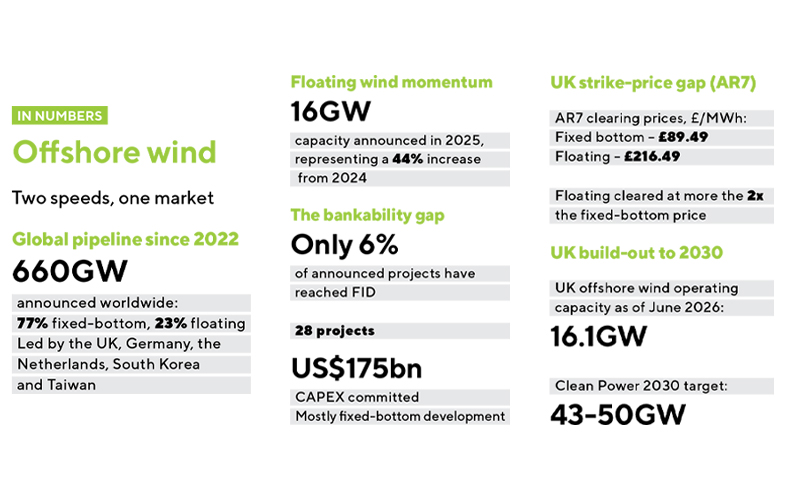
Around 16GW of floating wind capacity was announced worldwide in 2025 – a 44% increase from 2024. Despite this, fixed-bottom projects remain the industry’s foundation. Since 2022, EICDataStream has recorded 660GW of announced global offshore wind capacity, with fixed-bottom projects making up 77% of the total. The pipeline is led by established European markets such as the UK, Germany and the Netherlands, alongside key Asia Pacific (APAC) markets including South Korea and Taiwan (excluding China). Some 28 projects across Europe and APAC have reached final investment decision (FID), representing an estimated US$175bn in CAPEX and mostly being fixed-bottom developments. With only 6% of announced projects reaching FID, the data makes it clear that bankability remains elusive, even for established offshore wind technology.
Fixed-bottom bankability is not guaranteed
Technology maturity explains why fixed-bottom projects account for most FIDs, but it does not eliminate delivery challenges. Fixed-bottom wind benefits from proven foundation designs and established supply chains, giving developers and lenders greater confidence in project costs and schedules. Yet rising costs can still make projects unviable. In Japan, Mitsubishi-led consortia withdrew from three fixed-bottom projects totalling around 1.7GW in 2025 after low tariffs secured in 2021 failed to absorb inflation, higher financing costs and supply-chain pressures. Similar pressures have emerged across Europe. Denmark’s subsidy-free tender attracted no bids in 2024, prompting the Danish government to relaunch the programme with a two-sided Contracts for Difference (CfD) model. In the Netherlands, meanwhile, the Nederwiek I-A tender received no applications in 2025, leading the Dutch government to introduce subsidised tenders for the 2GW IJmuiden Ver Gamma-A and Gamma-B sites. This shows that auction design must provide both competitive prices and sufficient revenue certainty to support investment.
Floating wind’s added technical and industrial risk
Floating wind faces the same market pressures as fixed-bottom wind, but also greater technical and industrial risks. The technology remains less mature at commercial scale, and a limited pool of suppliers for mooring systems, anchors and dynamic cables continues to constrain deployment. Port and grid readiness add further bottlenecks, particularly as floating wind requires deepwater quays, heavy-load facilities and large assembly areas. Efforts to close this gap are underway: France’s Occitanie region is investing US$389m to upgrade the ports of Sète and Port-la-Nouvelle, while Spain has allocated US$242m to upgrade six ports. In addition, some markets are addressing grid constraints, including the UK’s proposed 4.5GW Celtic Sea network and transmission system operator-led connections in France and Norway. Even with these investments, commercial-scale capability is concentrated among relatively few companies and suppliers, limiting competition and adding pressure onto manufacturing capacity as projects scale up.
The UK’s two-speed pipeline
The UK experience reflects the offshore wind market’s two-speed development. Around 16.1GW was in operation as of June 2026 and the government is targeting up to 43–50GW by 2030, as set out under the Clean Power 2030 Action Plan. Allocation Round 7 (AR7) of the CfD scheme awarded approximately 8.4GW of offshore wind capacity, but only 2.3% was floating, through the Erebus and Pentland projects. Although policies such as the Clean Industry Bonus support supply-chain investment across both technologies, fixed-bottom projects remain better positioned to secure large awards. The strike-price gap makes this clear: the 1.38GW Phase B of the Berwick Bank fixed-bottom project cleared at £89.49/MWh, while the Erebus and Pentland projects cleared at £216.49/MWh – more than double the price. Floating wind is therefore being introduced more gradually while costs, infrastructure and commercial experience develop.
ScotWind’s floating ambitions meet reality
ScotWind shows a similar divide. Its 20 seabed option agreements represent up to 27.6GW, with approximately 17.8GW expected to use floating technology. However, these agreements grant development rights, not construction approval, and most projects still require consent, grid connections, revenue support and FID. Shell’s decision to return the 2GW CampionWind agreement in late 2025 is an early sign that part of this headline pipeline may shrink further as developers reassess commercial viability. The Celtic Sea’s Leasing Round 5 is also at an early stage. Its three projects, offering up to 4.5GW of floating capacity, have progressed to signed agreements for lease, though near-term work will stay focused on surveys, environmental studies, engineering, grid studies and ports preparation. Fixed-bottom activity, by contrast, is already visible on the water. That pattern looks set to continue: Leasing Round 6, planned for H1 2027, could offer approximately 6GW or more, predominantly through fixed-bottom projects off northeast England.
Want to know more about the renewables market?
Contact: hazwani.izzati@the-eic.com and beatriz.corcino@the-eic.com
Two markets, two sets of opportunities
The opportunity is therefore not one offshore wind market but two, each with distinct entry points. Fixed-bottom wind offers near-term work in foundations, substations, cables, vessels, marine logistics, commissioning and operations and maintenance, particularly for projects such as Dogger Bank, Hornsea 3 and East Anglia THREE. Floating wind creates longer-term opportunities in substructures, moorings, anchors, dynamic cables, port infrastructure and tow-out operations, with earlier demand for surveys and engineering studies. Existing oil and gas ports, yards and offshore expertise could also help suppliers enter the market.
Floating wind’s slower progress risks redirecting near-term capital and supplier attention towards fixed-bottom, but this does not diminish its long-term relevance: deepwater markets will still need it.
In 2026–2027, members should watch for project-level FIDs, CfD strike prices, auction participation and firm supply chain commitments. Developer willingness to bid will be a major test: Germany’s second offshore wind auction in 2025 attracted no bids for 2.5GW of capacity under its negative-bidding framework. Floating wind may offer long-term resource opportunity, but fixed-bottom projects are likely to dominate the near-term orderbook.
By Hazwani Izzati, Energy Analyst, EIC Asia Pacific and beatriz corcino, energy analyst, eic americas
Image credit | iStock



Follow us
Advertise
Free e-Newsletter