From ambition to execution: building Europe's SMR future
Europe’s SMR moment has arrived – proven technology, growing government backing and a mobilising supply chain mean the industry can now move from ambition to delivery, together.

Around the world, the conversation around small modular nuclear reactors (SMRs) has shifted from potential to delivery. In Europe, that matters more than ever.
Increasingly, governments are focused on energy security. Industry needs reliable, clean power. Electricity demand is rising fast, driven by advanced manufacturing, data centres and AI. Europe needs stable, low-carbon electricity at pace.
Nuclear energy has a central role to play, with SMRs, in particular, offering a practical route to cleaner, more secure, affordable and resilient power systems.
After years of announcements and promises, the industry has moved into a new phase. Success will not be measured by ambition, but by projects that break ground, supply chains that scale and partnerships that deliver operating plants. GE Vernova Hitachi’s SMR, the BWRX-300, is already showing what that looks like in practice.
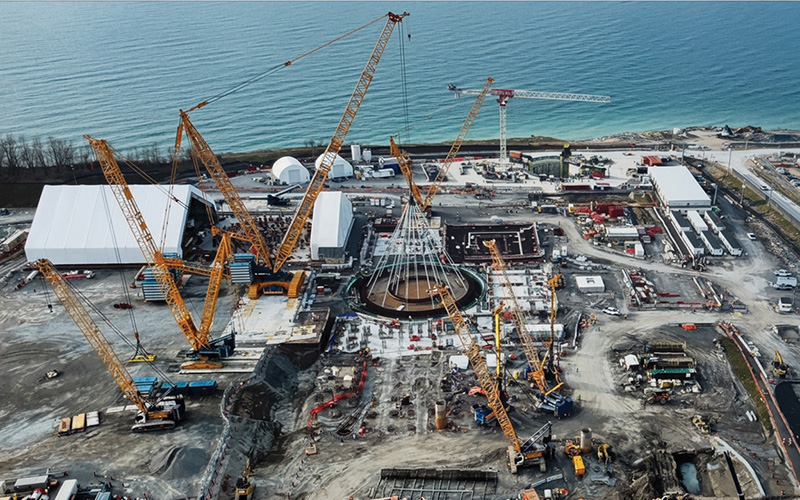
In Ontario, Canada, construction of the first BWRX-300 is advancing at Ontario Power Generation’s Darlington New Nuclear Project site. As the first commercial-scale SMR to begin construction in the Western world, Darlington is showing that advanced nuclear projects can move beyond planning and into reality.
A blueprint for Europe’s nuclear future
Every milestone achieved at Darlington will provide valuable experience for technology developers, suppliers, constructors, regulators and future customers. It is creating knowledge that will reduce risk and improve delivery for the projects that follow. That matters, because no one can build an SMR industry alone.
Delivering the next generation of nuclear power will require a strong industrial ecosystem. Engineering firms, manufacturers, construction companies and service providers will all have roles to play. The sooner that ecosystem is in place, the faster projects can be delivered safely, efficiently and at scale. Europe is well positioned to lead in this next chapter.
Across the continent, governments are recognising the role that nuclear can play in energy security, industrial competitiveness and decarbonisation. While each country will follow its own path, momentum is building behind advanced nuclear technologies that can be deployed faster, replicated across sites and integrated into wider clean energy strategies.
Momentum in the market
In Poland, ORLEN Synthos Green Energy (OSGE) has applied to Poland’s Minister of Energy for a Contract for Difference to construct 14 BWRX-300s at three locations. In the UK, Synthos Green Energy (SGE) has submitted an application under the government’s Advanced Nuclear Framework to support plans for multiple BWRX-300 units across up to three sites. These are important signals, as the future of SMRs will be defined by fleet deployment, not one-off demonstrations.
International collaboration is also deepening. GE Vernova, Hitachi, Samsung C&T and SGE recently announced a collaboration to explore opportunities to deploy the BWRX-300 across Europe. This kind of partnership reflects a simple reality: bringing advanced nuclear to market will require more than technology. It will need engineering capability, construction expertise, local supply chains and disciplined execution.

Reactivating the nuclear supply chain
The supply chain is crucial to successful deployment. Building a fleet of reactors means sourcing thousands of components and specialised services. It requires capabilities in advanced manufacturing, heavy fabrication, valves, pumps, instrumentation and controls, electrical systems, digital technologies, civil construction and long-term maintenance. Europe already has much of this capability.
For suppliers, the opportunity is bigger than a single project. It is a chance to participate in a long-term deployment programme that could extend across sites and decades. Those who prepare now will be best placed to capture that opportunity.
Investing in nuclear quality standards, workforce development, manufacturing capacity and strategic partnerships will be critical. Early engagement will build the confidence and capability needed as deployment accelerates.
Collaboration between technology developers and the supply chain must start early. Shared expertise, clear expectations and a joint commitment to delivery will be essential – that’s how projects move faster, reduce risk and create lasting value.
The energy transition is one of the defining industrial opportunities of our time. Realising it will take innovation, capital and sustained partnership across governments, utilities and industry.

The foundations are being laid. Projects are advancing. Customers are making decisions. Governments are establishing policy frameworks. Supply chains are building capability. The momentum behind advanced nuclear is real and growing. The question is no longer whether SMRs can contribute to clean, secure and reliable electricity, but how quickly we can build them.
By combining proven technology with strong partnerships and a world-class supply chain, we have an opportunity to change how nuclear projects are delivered, and to provide the reliable electricity that will support economic growth, strengthen energy security and underpin a lower-carbon future for generations to come
By Nicole Holmes, Chief Commercial and Regulatory Affairs Officer, GE Vernova Hitachi Nuclear Energy


Follow us
Advertise
Free e-Newsletter