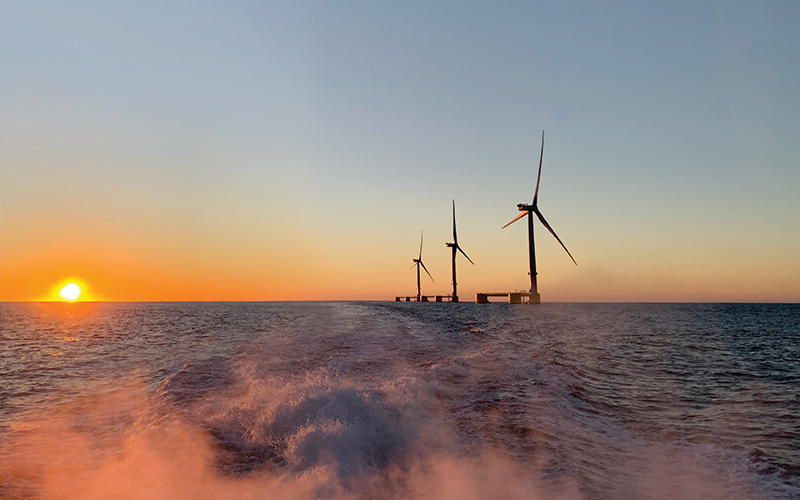
Cross-border offshore wind hubs with connections to more than one country will save money and space, and improve energy flows across Europe, says TenneT’s Michiel Müller

Cross-border offshore wind hubs with connections to more than one country will save money and space, and improve energy flows across Europe, says TenneT’s Michiel Müller

The UK’s offshore wind industry could sit front and centre in the UK’s post-COVID-19 economic rescue plan, and in the longer term be a guiding light in the transition to net zero.
More British businesses can supply offshore wind projects but developers need to engage better with a more joined-up supply chain, writes Rob Lilly at Vattenfall

Onshore wind is a mature and proven technology, playing a vital part in the UK’s energy mix.
Having been held back artificially for the past five years, the cheapest form of new power in the UK – onshore wind – is set to make a comeback, writes EIC analyst Sharanya Kumaramurthy

Heat decarbonisation in the residential sector – which is responsible for about a fifth of the UK’s greenhouse gas emissions – has been recognised by the Committee on Climate Change (CCC) as one of
The UK government’s new Clean Heat Grant shows tentative lessons have been taken from the failed Renewable Heat Incentive, writes Jess Ralston at the Energy and Climate Intelligence Unit

The world’s only floating nuclear power plant (FNPP), Akademik Lomonosov, commenced commercial operation on 22 May 2020.
Russia is getting closer to a small modular reactor reality, writes Rusatom Overseas President Evgeny Pakermanov

The nuclear industry has proven fertile ground for commercial disputes. Few industry sectors face sterner regulatory oversight or greater technical complexity.
When building a nuclear power plant, it is almost a case of when – not if – a dispute will arise. Understanding the risks is key to mitigating them, say partners at White & Case

During the past couple of years, activists have spurred a vigorous and much-needed debate over the future of energy and the planet.
Uniper CEO Andreas Schierenbeck sets out the company’s decarbonisation strategy and how other fossil fuel generators can reduce global emissions

Project LEO is a £40m+ multi-stakeholder consortium making Oxfordshire one of the UK’s largest testbeds for local energy systems.
The UK needs energy systems that are cheaper, cleaner and consumer-friendly. Project LEO (Local Energy Oxfordshire) has the potential to show just how innovation can deliver this energy ambition for the future, say Masao Ashtine and David Wallom at the University of Oxford

Today, refining companies face a more challenging and convoluted market. The growth of electric vehicles, more efficient internal combustion engines, and the world’s transition to a low-carbon econ
The transition to a low-carbon economy will require downstream organisations to invest in low-carbon technologies. EIC analyst Tayo Idowu looks at the disruptive technologies transforming the downstream industry

Follow us
Advertise
Free e-Newsletter